
How to Build Raised Beds for Better Drainage on Clay Soil
If you’ve ever stood in your garden after a wet winter, staring at puddles that refuse to drain and wondering when you can actually plant, you’re certainly not alone. Heavy clay soils are common across much of southern England, including Buckinghamshire, and they can make gardens feel slow to warm, hard to work, and difficult to establish. Water can linger after rain, roots may struggle for air, and spring jobs often start later than expected.
Raised beds can be a practical way to improve growing conditions on clay, but they are not a universal fix for every wet garden. They tend to help most where the main issue is compaction, dense subsoil, or seasonal saturation. If water stands across the wider site for days at a time, a raised bed may still help the root zone, but wider drainage limits may also need attention.
This guide explains why clay soils behave the way they do, how raised beds can improve root-zone drainage and soil structure, and how to build them so they are more likely to perform well over time.
This advice is framed for common clay conditions in this part of the UK and is intended to help readers match raised bed design to the cause of poor drainage, whether that is compaction, seasonal wetness, or wider site water movement. The same principles can often be used in other areas with heavy clay soils, including parts of London, Hertfordshire, Bedfordshire, Oxfordshire, and Berkshire, though site conditions still vary.
A quick check before you build
Water sits for a few hours after heavy rain, then clears
Water sits for days across several parts of the garden
Soil feels compacted from foot traffic or building work
Plants grow in summer but struggle after wet winters
The bed area is lower than surrounding ground
Roof or paving runoff reaches the planting area
If your issue is mostly compaction and seasonal wetness, raised beds often help. If water remains for days across the wider garden, treat raised beds as part of the solution rather than the whole solution.
Explore this guide
If there’s one section to start with, begin with Why raised beds improve drainage on clay soil. Then check Common mistakes to avoid before you build.
Why clay soil causes drainage problems
Clay soil is made up of very fine particles that pack tightly together. That structure can hold nutrients well, but it also tends to drain slowly, especially during prolonged wet periods.
Conditions vary across the area. In the Aylesbury Vale, low-lying areas can contain deep, sticky clay that may stay saturated for long periods in winter. In the Chilterns, soils may sit over chalk, but clay layers can still compact heavily under foot traffic and construction machinery, especially on flatter plots.
On many new-build sites, these issues can be worse. Topsoil is often stripped or thinned during development, leaving compacted subsoil beneath. As a result, grass, vegetables, and ornamental planting may struggle to establish because roots cannot penetrate easily and oxygen levels in the soil stay low.
Why raised beds improve drainage on clay soil
Clay soils can hold a lot of water, which can be helpful in summer, but they can drain slowly in winter when the ground is cold and saturated. Clay particles are small and pack tightly, and when soil is compacted, water has fewer pathways to move through. That can leave roots sitting in low oxygen conditions, which increases stress and can reduce growth.
Raised beds help by lifting the root zone above the densest and wettest layers, giving you a defined space to build a more open soil structure. They can also reduce compaction, since beds are normally worked from the edges rather than walked on.
In RHS guidance on wet soils, raised beds are recommended where drainage is limited by heavy layers or impervious ground, which is a useful benchmark when deciding whether your issue is root-zone compaction or a wider site problem.
Use the table below to decide what raised beds can improve directly, and where expectations need to stay realistic.
| How Raised Beds Help | What Happens on Clay Soil | Why It Matters Locally |
|---|---|---|
| Allows better soil structure | Soil mix can be balanced for drainage and airflow | Reduces reliance on heavy native clay alone |
| Supports deeper root growth once established | Roots can grow more freely in looser, better aerated soil | Can improve resilience through wet winters and summer dry spells once established |
| Can improve root-zone drainage | Excess water is less likely to pool around roots, provided water can move away below the bed | Can reduce rot risk during prolonged wet periods |
| Lifts roots above compacted layers | Roots are less likely to sit directly in dense, seasonally waterlogged clay | Can reduce root stress linked to winter wetness common in parts of the Vale and Thames Valley |
| Reduces compaction from foot traffic | Beds are worked from the edges, not walked on | Helps maintain soil structure over time |
| Often warms and dries the bed surface faster in spring | Raised soil often dries and warms more quickly at the surface | Can support earlier planting windows and steadier early growth |
For gardeners dealing with compacted clay and seasonal wetness, raised beds often deliver noticeable improvements within a single growing season. That is usually faster than improving clay in place alone, which can take longer to show reliable changes in structure
Choosing the right height and depth for raised beds
Depth matters more than many people realise. Shallow raised beds can improve access and help shallow-rooted crops, but they may not improve drainage enough for deeper-rooted planting if roots quickly reach compacted clay beneath.
As a general guide
30 cm can work for shallow-rooted crops and herbs
45 to 60 cm is often a good range for vegetables, shrubs, and mixed planting
60 cm or more may be worth considering where clay is especially dense or drainage is poor

On clay soils in the county, deeper raised beds can help roots sit higher above compacted subsoil, improving drainage and long-term plant health compared with shallow builds.
In heavier local soils, deeper beds are often worth the extra effort, especially for mixed planting and longer-term root development.
It also helps to think in trade-offs. Deeper beds can improve root-zone conditions and flexibility, but they cost more in materials and fill. They can also dry more quickly in warm weather, so watering may need more attention in summer.
Preparing the ground beneath the bed
Even though raised beds sit above ground level, what lies beneath still plays an important role in long-term drainage and root health. Preparing the base properly helps improve the transition between the raised bed and the native ground below.
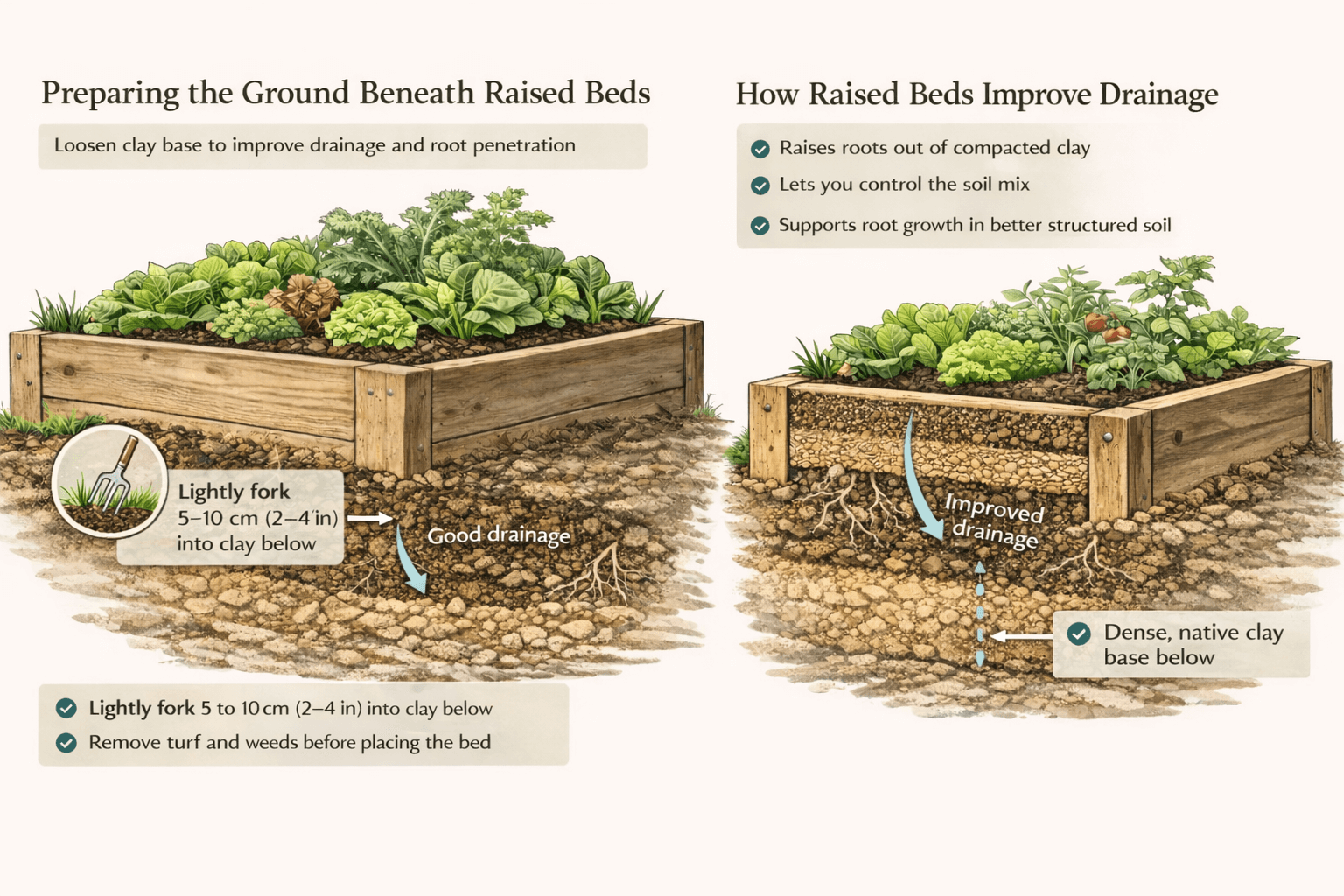
Before building, take time to
Remove turf, weeds, and obvious rubble
Loosen the soil below with a garden fork to reduce compaction and improve infiltration
Avoid working the soil when it is wet, as this can smear clay particles together and worsen drainage
There is often no need to excavate deeply or replace the underlying soil entirely. In many gardens, lightly opening up the surface is enough to improve root access and help water move through the bed profile more reliably. If water stays trapped for long periods across the wider area, wider drainage measures may still be needed.
A no-dig approach can also work well on clay, especially where you want to minimise disturbance. Cardboard can help suppress weeds where pressure is high, but it is not always necessary in every build. Garden Organic guidance on no-dig methods is a useful reference point for using cardboard as a light-excluding layer rather than as a drainage layer.
Over time, worms and soil organisms can improve the interface between the raised bed and the clay beneath, which may support better structure without repeated heavy digging.
If you are using a no-dig start, keep expectations clear. Cardboard helps with weed suppression and establishment. It does not solve a wider drainage problem on its own.
Illustrated infographic showing how to prepare clay soil beneath raised beds and how raised beds improve drainage by lifting roots above compacted clay and using a better structured soil mix.
Choosing materials that last in Buckinghamshire conditions
Damp winters and freeze-thaw cycles can be hard on raised bed materials, especially when beds are deep and filled with heavy, wet soil.
Common options include
Timber, pressure-treated wood or naturally durable species such as cedar often last longer than untreated softwood, which may rot sooner in wet conditions
Metal, galvanised steel beds can resist bowing caused by soil expansion in winter and can suit contemporary gardens
Brick or stone, very durable and stable, though they may stay colder in spring, especially in shaded spots
Whatever material you choose, make sure fixings and joints are robust enough to cope with wet, heavy soil and seasonal movement.

Different raised bed materials perform differently on clay. Choosing a durable build can reduce maintenance and keep the bed shape stable while the soil settles.
The best soil mix for raised beds on clay
What you fill a raised bed with matters just as much as how it is built. A common mistake is filling beds with pure compost. It can be nutrient-rich, but it may slump, hold too much water in winter, and dry out quickly in summer.
A balanced mix usually performs better as a starting point
50% screened topsoil for structure
30% well-rotted compost for nutrients and biology
20% sharp horticultural sand or grit to improve drainage and pore space
In heavier Vale clay areas, you may need to adjust the grit content slightly. A simple field check is to squeeze a handful of the mix. It should hold together briefly, then crumble fairly easily rather than forming a sticky ball. This is a quick practical check, not a full soil assessment.
Avoid builder’s sand, which can bind with clay and make structure worse.
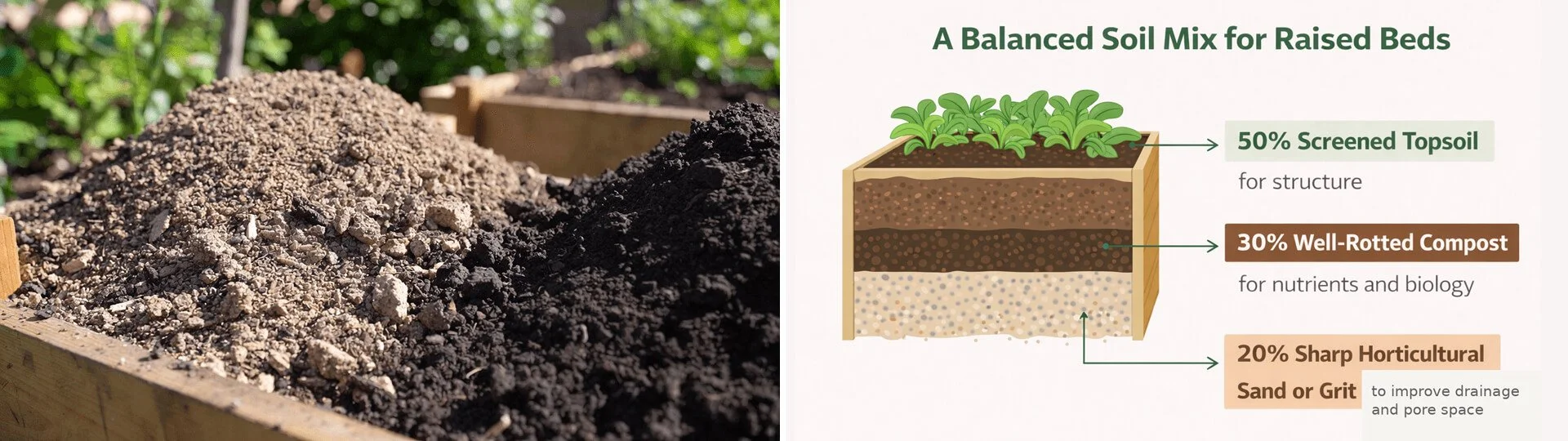
A practical guide to building a free-draining raised bed on clay, using topsoil for structure, compost for fertility and grit for flow.
Common mistakes to avoid
Most raised bed problems on clay are not caused by poor planting, but by a few predictable construction and preparation missteps. Because clay behaves differently to lighter soils, well-meant shortcuts can reduce the benefits raised beds are meant to provide.
The table below highlights issues seen regularly in gardens like these and the adjustments that usually work better.
| Common Mistake | Why It Causes Problems | What Works Better on Clay |
|---|---|---|
| Adding gravel layers at the base | Water can sit above the gravel-clay boundary, creating a perched water table | Skip gravel layers in most raised beds on clay, and improve drainage through bed height and a suitable soil mix instead |
| Beds built too shallow | Roots can quickly reach compacted clay beneath, which may reduce drainage gains and restrict growth | Around 45 to 60 cm total depth often works well for mixed planting on compacted clay, while shallower beds may still suit herbs and salads |
| Ignoring compaction beneath the bed | Roots may still struggle once they hit dense clay below the raised area | Lightly fork or spike the base before building, provided the clay is not wet enough to smear |
| Overworking soil when wet | Working wet clay can smear particles together and reduce natural drainage channels | Only work soil when it crumbles in the hand, and let winter-wet beds dry before intervention |
| Using pure compost to fill beds | Compost can slump, hold too much water in winter, and dry out rapidly in summer | Use a balanced mix of topsoil, compost, and grit as a starting point for structure and drainage |
It is also worth knowing when raised beds are not enough on their own.
Persistent standing water across most of the garden
Runoff collecting from patios, paths, or neighbouring levels
A naturally low point where water gathers repeatedly
Signs of a high winter water table
Heavy compaction around the bed area from recent building work
Slow drying due to shade and limited airflow
In these situations, raised beds can still improve the root zone, but site drainage and water flow may also need attention.
Ongoing care and realistic expectations
Raised beds can significantly reduce drainage problems on heavy clay, but they are not maintenance-free. Like all good garden structures, they benefit from light, regular observation rather than heavy intervention.
After periods of prolonged winter rain, it is worth watching how water behaves in the bed. If pooling or surface compaction appears:
Gently fork the surface once conditions have dried enough to avoid smearing
Top up organic matter annually to maintain structure and biological activity
Avoid standing or sitting on bed edges, which can compact the soil over time
Short-term surface saturation after heavy rain can be normal on clay and does not always mean the bed has failed. Repeated standing water that lingers for days, especially when surrounding ground is also saturated, usually points to a wider drainage limit rather than a bed-fill issue alone.
It also helps to understand what tends to improve first and what takes longer.
First season, easier planting, better workability, and less root stress in the raised zone
After the bed settles, more stable moisture handling with regular top-ups and mulch
Longer term, surrounding clay can still limit results if wider drainage remains poor
Amending clay in place can work well, but it usually takes patience and repeated additions of organic matter before structure changes become obvious. Raised beds can deliver usable growing conditions more quickly while that longer process continues.
A simple seasonal routine can keep beds performing well.
Late winter, check how long water sits after heavy rain
Spring, top up compost or mulch and note settlement
Summer, monitor drying and irrigation needs
Autumn, avoid compacting wet soil and tidy edges before winter
Lightly forking the surface of raised beds once soil has dried can help relieve compaction without damaging structure, which is often enough for routine winter care.
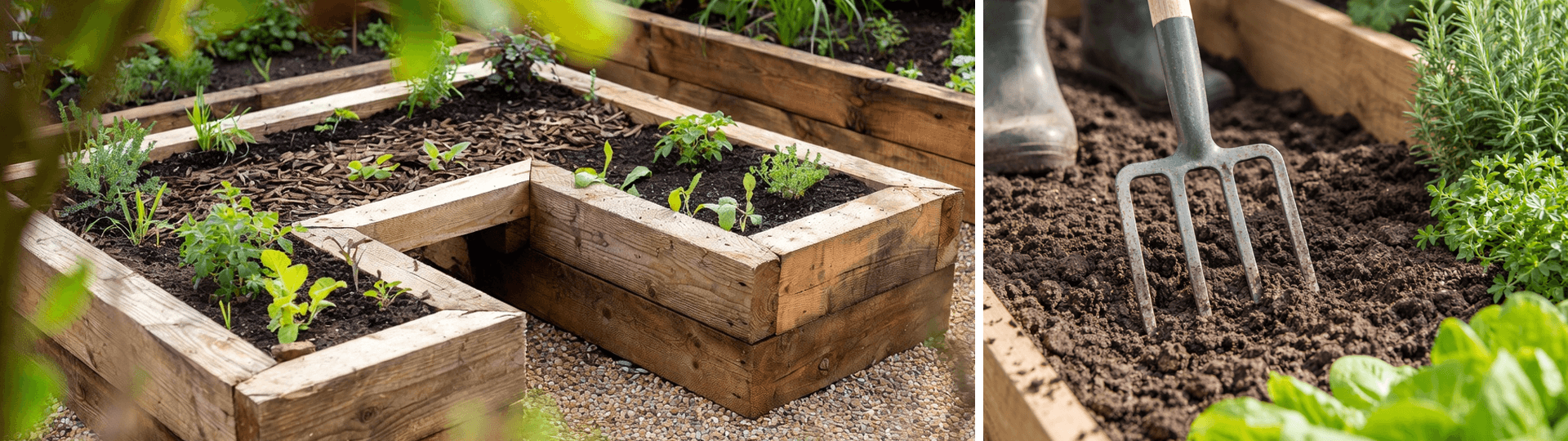
Lightly forking the surface of raised beds once soil has dried helps relieve compaction without damaging soil structure, an important part of winter care on clay soils.
FAQ
When is the best time to build raised beds on clay soil?
If waterlogging is a problem, building in late summer or early autumn can be easier because the ground is often drier and less likely to smear when you loosen the base. Spring can also work if the soil is moist but crumbly, not sticky. If clay smears on tools, it is usually too wet to work without damaging structure.
How should raised beds be watered so they do not dry out too fast in summer?
Raised beds can dry faster than surrounding ground, especially in warm, windy weather. A useful approach is to water less often but more thoroughly, aiming to soak the root zone rather than wetting the surface. Mulch usually helps slow evaporation and keeps moisture levels steadier. Adjust frequency based on weather and planting, and do not aim to keep soil constantly wet, as roots also need air.
How can you reduce slug and snail damage in raised beds without heavy chemical use?
Raised beds do not automatically stop slugs. In many gardens the most realistic aim is management rather than elimination, focusing protection on seedlings and new growth. Practical options include encouraging predators, planting sturdier transplants, checking on mild damp evenings, and using targeted barriers where they genuinely help. Home remedies vary in effectiveness, so it is worth being selective and testing what works in your own garden.
Is it safe to use new treated timber or sleepers for edible raised beds?
The RHS notes that new sleepers and treated wood do not contain older, more harmful chemicals, and are considered fine for edible crops. If you want to be extra cautious, you can line the inside faces, though the RHS also notes this is less desirable if you are trying to reduce plastic use. In practice, choosing reputable suppliers and avoiding old reclaimed materials of unknown treatment tends to be the sensible risk-reduction step.
What areas in the UK have clay soil?
Clay is widespread across the UK, but it can change over short distances, even within the same town. The most reliable way to check is to use a soil map for your specific location rather than guessing by county. A national map tool such as the UK Soil Observatory can help you check local soil type and related properties.
A practical solution for your gardens
Raised beds are not just a design feature. When built properly, they can be one of the most effective ways to garden successfully on clay soil.
By focusing on depth, soil balance, and thoughtful construction, you can make difficult ground much easier to work with through wet winters and variable seasons. The strongest results usually come from matching the build to the actual problem, whether that is compaction, seasonal saturation, or a wider drainage limitation.
Once your raised beds are settled and thriving, a few reliable self-seeding plants can add low-maintenance cover, soften edges, and fill gaps naturally with less replanting each year. If you are also deciding what to plant in heavy clay, low-maintenance plants for clay soil in areas such as Buckinghamshire can help you choose reliable options for structure, colour, and seasonal interest.
If you are planning raised beds and want advice tailored to your soil, drainage, and layout, a site-specific approach can help avoid overspending on bed height or fill that does not address the actual cause.
An initial conversation can help clarify what is likely to work best for your space, whether you are growing vegetables, herbs, or ornamental planting. Thoughtful planning at the outset often saves time, effort, and disappointment later on, and helps raised beds settle in well for years to come.