
5 Reasons Your New Buckinghamshire Lawn Is Struggling and the Local Fixes That Work
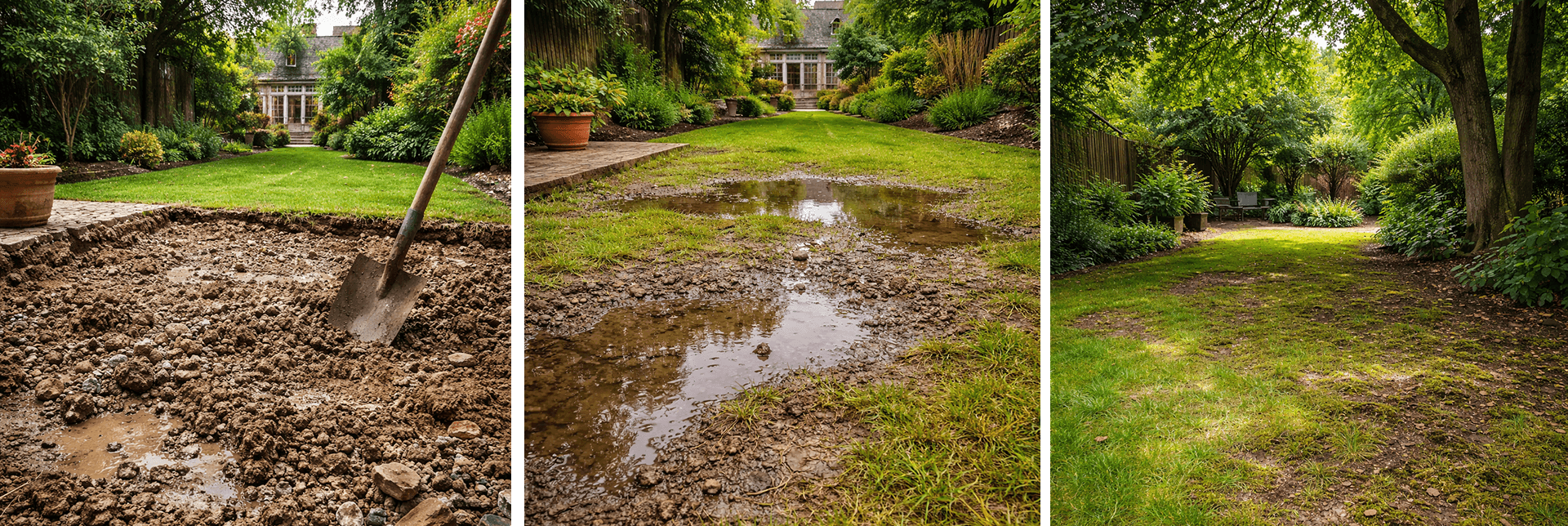
Roughly one in three of the lawn callouts we take in Buckinghamshire is not a lawn problem at all. It is a soil problem that only became visible once the grass went down. The pattern is nearly always the same: turf laid in spring, looking well by June, patchy and yellowing by the following March, with soggy corners that never quite dry out. By the time we are asked to look at it the homeowner has usually already spent money on reseeding, feed and a couple of bags of topsoil, none of which touched the cause. This article sets out the five faults we find most often on Buckinghamshire ground, how to test for each one yourself in under ten minutes, and what actually fixes them.
New-build gardens are the worst offenders, and we see the same thing on estates across Aylesbury, Buckingham and the newer developments around Milton Keynes. Tracked machinery works the plot for months, the original topsoil goes off site, and what comes back is a thin skim of soil over compacted subsoil with brick, mortar and builders' sand underneath. On one Aylesbury plot we lifted failing turf and hit builders' sand at 90mm, which is less than the depth of the turf's own root zone. Nothing was ever going to grow in it. So before you change seed, add feed or top dress, run three checks: where does water sit twenty-four hours after rain, can you push a garden fork in 10 to 15 cm without leaning on it, and does the area get four or more hours of direct sun. Those three answers tell you which of the five faults below you are dealing with..
Our mix of heavy clay soils around the Aylesbury Vale and chalkier ground in the Chilterns, combined with unpredictable rainfall and wet winters, creates real challenges for grass. Across Buckinghamshire, the same handful of problems come up time and again, especially heavy soils, disturbed ground on new builds, and shade from mature trees.
The best part? They are often fixable without tearing everything up and starting again. If the lawn is failing across most of the area and you hit rubble, builders’ sand, or compacted subsoil within the first spade depth, a partial strip and rebuild may be a better use of money than repeated surface repairs.
Common Challenges and Their Fixes
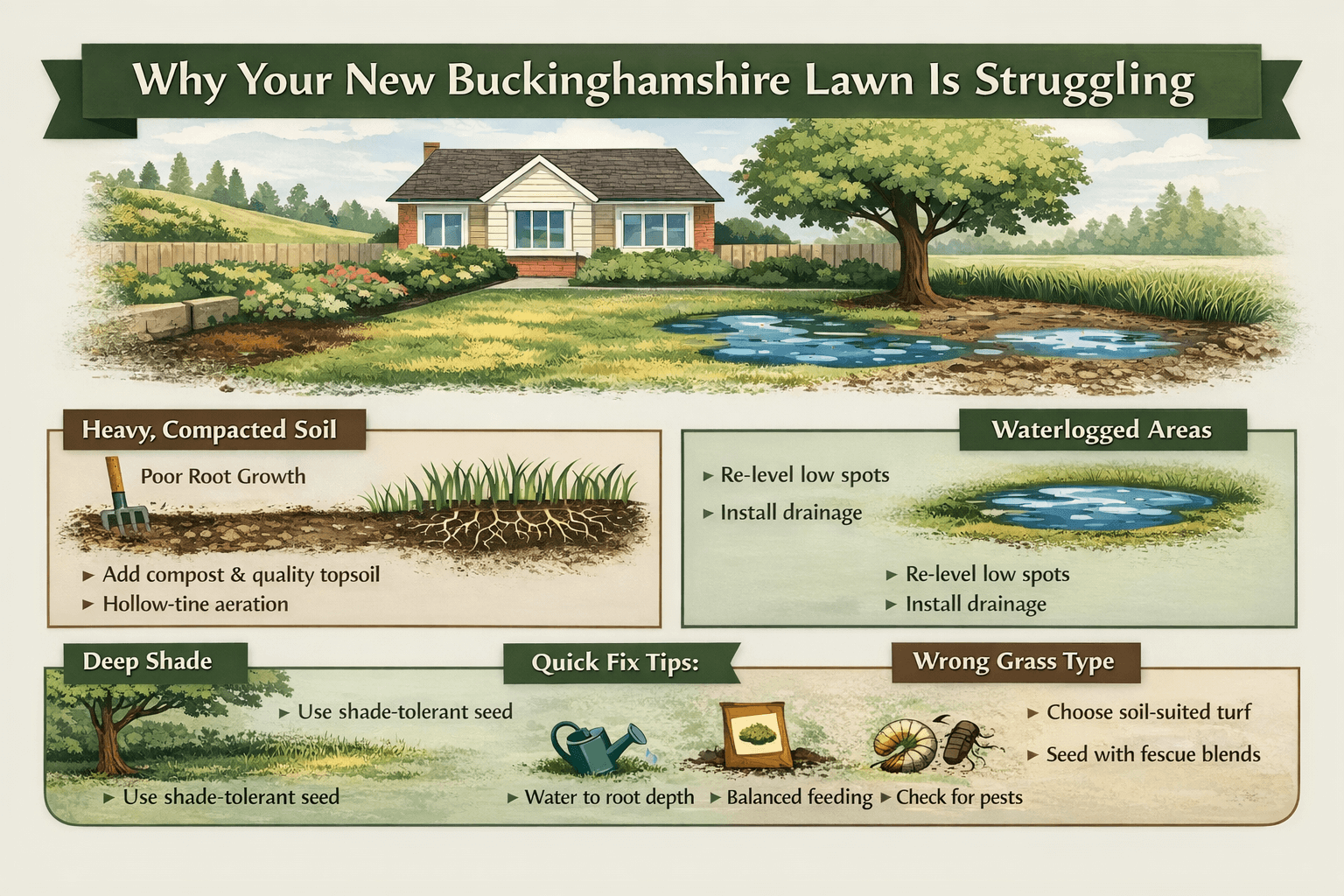
Infographic showing common causes of new lawn failure in Buckinghamshire including compacted soil, drainage issues, shade, and grass choice.
1. Inadequate soil preparation on heavy clay
Buckinghamshire's natural soil can be stubbornly heavy, and new-build sites often suffer the worst compaction from machinery, with decent topsoil removed and subsoil left rock-hard. Older gardens face similar issues from years of foot traffic. Grass roots simply cannot penetrate properly. Water either sits on the surface causing puddles or moves unpredictably through disturbed soil layers, leaving roots shallow and the lawn vulnerable.
A quick check is the fork test. After a decent soak, push a garden fork in. If it still will not go in easily, compaction is likely. Another check is a simple soak test. Pour a watering can onto a small patch and see whether it soaks in within 10 to 15 minutes. If it pools or runs off, you are usually dealing with compaction, clay structure, or both.
Practical fixes
Work in 100mm to 150mm of screened BS 3882 topsoil, choosing a texture close to your existing soil. 100mm is the working minimum for turf and 150mm gives the roots useful reserve in a dry summer. Deeper than that is money spent on soil the grass will never reach. What matters far more than depth is the join: fork or rotavate the new soil into the top of the existing ground rather than laying it as a clean layer. On clay a neat unblended layer creates a perched water table, where water sits on the interface between the two soils and keeps roots shallow and permanently wet. That is the fault we correct most often on lawns that were laid by someone who did everything else right.
On tough clay, mix in generous amounts of well-rotted organic matter such as manure or garden compost to improve soil structure gradually over time. Blend it through rather than leaving a separate band that roots struggle to cross.
If the ground feels rock-solid or contains rubble, consider mechanical loosening or hollow-tine aeration to open the soil before turfing, or as a remedial step once grass is established. Hollow tining can be more effective than spiking alone on compacted clay, especially if you then brush a free draining top dressing into the holes, and the same principles sit behind improving clay soil where water lingers near the surface.
2. Poor drainage from uneven ground or incorrect levels
Even a subtle slope towards the house, patio, or a low spot can create permanent wet patches after rain, especially on clay that holds water tightly. In winter, slower drainage can be normal on heavy soil, but repeated pooling in the same spots usually points to levels, compaction, or runoff from hard surfaces.
Quick test. After heavy rain, check the lawn the next day. Any standing water after 24 hours signals trouble. If it has been very wet or cold and the ground is already saturated, use this as a prompt to investigate rather than a hard pass or fail.
Straightforward solutions
Re-level problem areas with imported topsoil, which is often more effective than repeated surface repairs. Aim for gentle falls that move water away from buildings and seating areas, without creating a low bowl elsewhere.
For persistent issues, install simple French drains or land drains leading to a soakaway, ensuring they are positioned away from buildings and boundaries. Only do this if you have a suitable place for the water to go. A drain without an outlet can simply shift the problem.
Raise sunken patios slightly to stop runoff sheeting onto the grass, and build subtle falls into the ground preparation so water moves away rather than collecting. If runoff is the main cause, a narrow planted strip that absorbs the water will often do more than a drain, and it costs a fraction as much. Where the wet spot is a border rather than lawn, the simplest answer is usually to stop fighting the clay and lift the planting above it. We cover that approach in detail in our guide to building raised beds for better drainage on clay soil, which uses the same principles as the lawn work here but is a great deal easier to get right.
3. Too much shade from trees or north-facing boundaries
The mature oaks and beeches common across the Chilterns and the older Buckinghamshire villages cast a shade that no standard lawn mix will cope with. There is a hard limit here worth knowing before you spend anything: even the most shade-tolerant turf species, the fine fescues and turf-type tall fescues, need around four hours of direct sunlight a day. Below that threshold no grass will hold, and no seed mix, feed or top dressing will change it. If your problem area sits under four hours you are choosing between reducing the canopy and giving up on grass in that spot, and we will say so on site rather than sell you a repair that will fail again next winter. Damp shade also favours moss, so persistent moss under a tree is usually a light problem being blamed on a feeding problem.
Warning signs include thin, stretched grass, widespread moss, or bare earth directly beneath branches.
Effective options
For light to medium shade, use a specialist blend built on fine fescues, chewings and slender creeping red in dry shade, hard fescue where it is drier still. For the damp shade typical of clay under a canopy, a mix including rough-stalked meadow grass will hold better than fescue alone. We would steer you away from browntop bent here despite it appearing in some shade mixes: it needs close mowing, regular feeding and active thatch management, it is prone to disease in humid conditions, and it does not cope with heavy shade. It belongs in an ornamental lawn in good light, not under an oak. Whatever you choose, a shade blend will not take heavy wear, so keep the trampoline and the football off it.
Opt for a low-maintenance fine-fescue lawn, which stays greener in shade and requires less intervention. Keep the cutting height a little higher in shade to support the plant.
In very dense shade, replace affected patches with robust ground covers such as ajuga or pachysandra in suitably sheltered, moist conditions for year-round interest. Another option is to reduce the lawn footprint and treat the shadiest zone as planting, which often looks better than repeated patching.
4. Wrong choice of grass seed or turf for local conditions
Off-the-shelf universal mixes are usually dominated by ryegrass, which demands heavy feeding and frequent cutting while often performing poorly on heavy clay. Poor-quality turf can also introduce hidden problems. Ryegrass can still work in a hard wearing family lawn, but it often needs better soil preparation and more consistent aftercare than people expect.
Better matches for Buckinghamshire gardens
Choose turf from reputable suppliers offering blends that include dwarf ryegrass and fescues suited to heavier soils. Ask what is in the mix so you can match it to wear, shade, and how often you mow.
When seeding, select varieties containing slender creeping red fescue, chewings fescue, and tall fescue. Tall fescue’s deeper root system can help it cope better with heavier soils and occasional dry spells.
5. Over-feeding or feeding at the wrong time
In eagerness to encourage growth, many apply strong nitrogen-rich feeds too early. On clay soils this produces soft, lush growth that weakens quickly when conditions change and can contribute to disease issues. If you see very fast top growth but the turf lifts easily, feeding may be masking a rooting problem rather than fixing it.
A gentler approach
Get the phosphate in before the turf goes down, not after. A pre-turfing fertiliser raked into the prepared surface is where establishment nutrition belongs. Once turf is laid, hold off on any further feed for the first six to eight weeks while the roots knit.
The first real feed should be an autumn one: high potassium, low nitrogen. Potassium hardens the plant for winter wet and cold. Nitrogen at that point does the opposite, pushing soft growth into exactly the conditions that will damage it.
Feed again in spring only after several cuts and once you can see genuine root development. Test by lifting a corner: if the turf comes away easily it is not ready, whatever the top growth looks like.
If moss or algae are your main complaint, feeding is the wrong lever entirely. Moss is a symptom of shade, wet or compaction, and killing it without fixing the cause simply clears space for next year's crop.
Keeping your lawn healthy long term
Regular maintenance helps lawns stay strong and resilient year after year. In Buckinghamshire’s heavier soils and wet winters, small problems can build up if they are ignored. A simple routine that often works is deal with thatch first, relieve compaction next, then top dress lightly if the soil needs it.
Essential annual maintenance
Scarify and aerate when conditions allow, ideally in autumn when the soil is moist but not saturated.
Heavier soils compact more quickly, particularly in gardens that see regular use.
Removing surface thatch and relieving compaction improves airflow, drainage, and root growth over time.
A thorough pass with a scarifier followed by hollow-tine aeration where compaction is evident helps keep air, water, and nutrients moving through the soil profile. On clay, avoid working the lawn when it is very wet, as this can smear the soil and reduce drainage further.
Key Early Care for New Lawns
Water consistently during establishment, keeping the soil evenly moist rather than saturated. Make sure water soaks through the turf into the soil beneath rather than just wetting the surface.
In dry or warmer weather, this may mean watering daily for the first few weeks. As the turf starts to resist a gentle lift at the corner, move towards fewer, deeper waterings when conditions allow.
Keep off new turf until it has rooted, usually two to three weeks, and test rather than count days: lift a corner, and if it resists, it is knitted in. New lawns from seed need longer, closer to six weeks before any real traffic.
Timing of the first cut differs between turf and seed, and mixing the two up is a common cause of early damage. Turf is ready once it has rooted and is growing, cut on a high setting at around 50mm with sharp blades. Seed should be left until it reaches 70mm to 80mm before its first light topping. Either way, never remove more than a third of the leaf in one pass.
Early turf aftercare often fails when watering only wets the surface, and the approach outlined in watering and soil drainage from a turf supplier aligns with the aim of soaking through to the root zone without leaving the surface waterlogged.
These steps help young lawns establish evenly and reduce stress during the most vulnerable early stage.
Pest Awareness
Watch for early signs of pests, particularly chafer grubs and leatherjackets, which can appear in Buckinghamshire gardens. Birds pecking repeatedly at the same area can be a clue, but confirm by lifting a small square of turf and checking the top few centimetres of soil.
Damage often shows as yellowing and thinning patches that can be lifted more easily than healthy grass.
Strong, well-rooted turf is less vulnerable, so focus first on soil structure, drainage, and balanced aftercare before considering targeted controls.
If a section of lawn has failed twice for the same reason, shade or standing water, a third attempt at the same fix is money spent on a result you already know. In those cases we will normally recommend shrinking the lawn footprint and treating the difficult zone as planting instead. It is a smaller invoice for us and a better garden for you, and on heavy clay plots with mature trees it is the recommendation we give most often. If you are wondering what would actually thrive in that spot, our list of ten low-maintenance plants for Buckinghamshire clay soil is the place to start. Vivid Gardens has been building and rebuilding lawns on Buckinghamshire clay since across gardens in Aylesbury Vale, the Chilterns and the surrounding villages. If a lawn keeps failing on you, we will come and dig a hole in it and tell you what is actually down there.