
Garden Design and Hard Landscaping in Beaconsfield
Vivid Gardens is a Beaconsfield-based garden design and hard landscaping practice led by garden designer and horticulturist Erika Meh. We work across the town and surrounding villages, on everything from a new terrace or retaining wall to complete garden redesigns.
Erika has a Master’s degree in Ornamental Horticulture and more than twenty years of hands-on experience. She leads the design, planting strategy and key decisions that shape how each garden looks, works and matures over time.
For larger or more technical gardens, Erika works with trusted landscape contractors and specialist trades selected for the particular needs of the project. This may include groundworks, drainage, paving and retaining, joinery, irrigation or lighting. The design carries through to the finished garden. You are not handed a drawing and left to find someone to build it. We agree the scope, delivery approach and who is responsible for what before work begins.
Being based here matters more than it sounds. Beaconsfield is really two towns, and they often ask different things of a garden. The Old Town has period properties within a conservation area. Gardens there are often walled and enclosed, and anything new needs to sit comfortably against Georgian and Tudor brick. The New Town, north of the station, has Edwardian and 1930s houses on more generous plots. Those gardens often have mature trees, long boundaries and levels that fall away towards the railway.
Different gardens bring different problems, but the underlying question is the same. What should be built, retained and planted so that the whole garden works, not just when it is finished, but for years afterwards?
Hard landscaping that lasts longer than the fashion
Most of what makes a garden work gets built before anything is planted. Terraces, steps, paths, retaining, edges and levels are the bones. If the bones are wrong, no amount of planting rescues it.
The ground here is clay with flints. It holds water through winter and sets hard in summer. That makes foundations, drainage and edge detailing matter more than people expect. We would rather spend an extra day on the base than watch a beautiful terrace lift and shift in its third winter.
Materials matter just as much, and they matter differently on each side of town. Against Old Town brick and flint, a heavy contemporary porcelain can look like it landed from somewhere else. A well-chosen stone settles in and looks like it was always there. On a larger New Town plot, retaining is often the thing that unlocks the garden. It turns an awkward slope into a terrace you would actually sit on. We work all of that out at the design stage, because the cheapest time to solve a level change is on paper.
Old Town gardens, and what the conservation area means for them
The Old Town Conservation Area was designated in 1969. It covers much of the historic centre, and there are a good number of listed and locally listed buildings, plus Article 4 directions. In practice that means some changes which would be permitted development elsewhere may need consent here. Design decisions carry more weight too. Boundary treatments, terrace materials, how the garden reads from the street, how new work sits against old brick.
None of that makes a good garden harder to achieve. It just means the thinking comes first. We will flag anything that looks like it may need permission early on, and point you to the council for the answer on your specific property rather than guessing.
New Town gardens, and making a big plot work
North of the station the plots get generous and the problems change. Mature trees, long boundaries, ground that falls away, and layouts drawn up for a way of living nobody has now. The most common thing we hear is that the garden is big but only a fraction of it gets used.
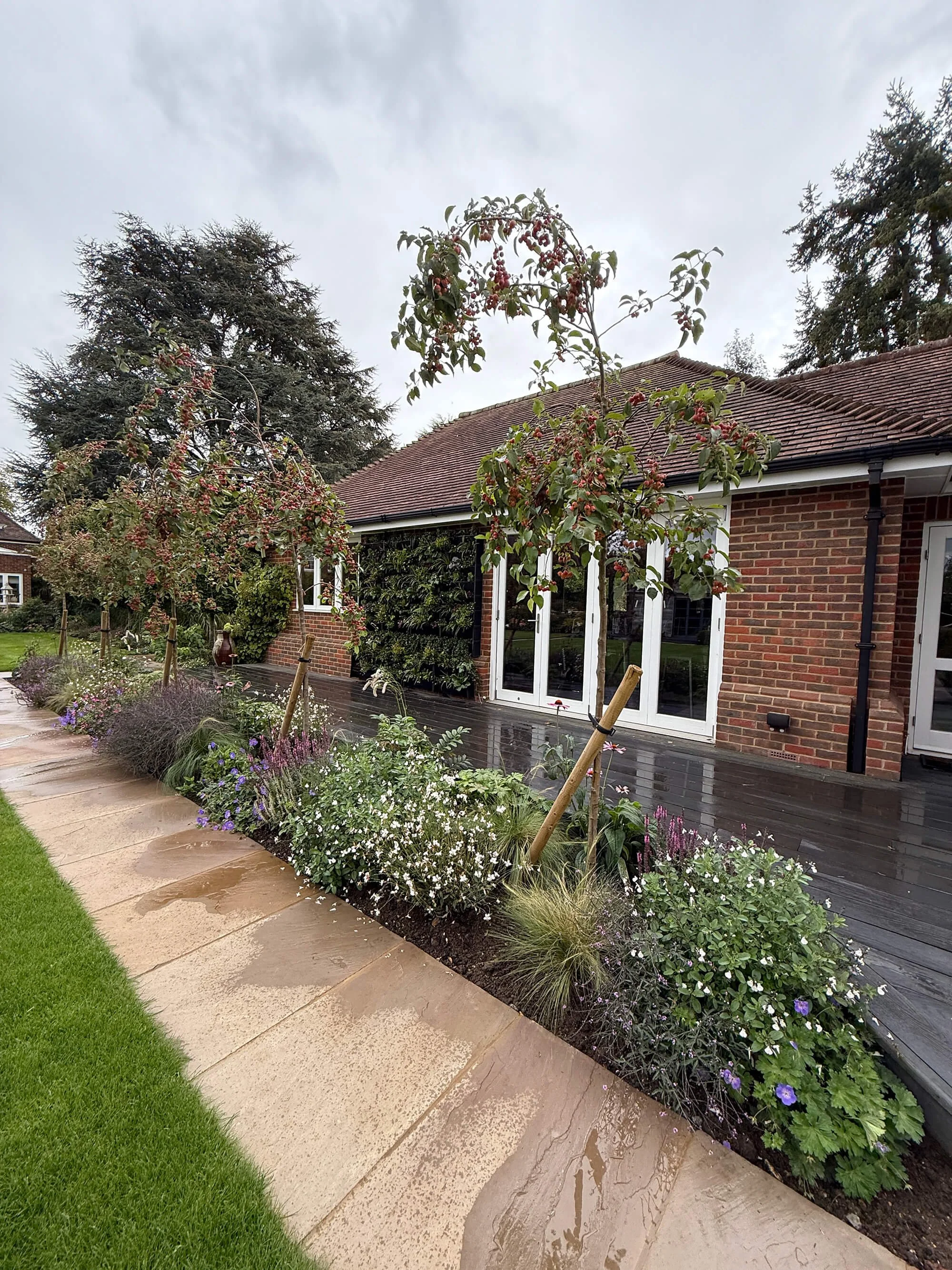
The fix is usually structure rather than more planting. A terrace positioned for the evening sun rather than for the back door. Levels resolved with retaining, so the space becomes usable. A route that makes you want to walk the whole garden. Then planting chosen for the ground it is actually going into. Clay with flints is demanding, and it rewards a considered palette. Our guide to low-maintenance planting for Buckinghamshire claycovers what genuinely performs here over the long term. For the shadier corners under mature trees, self-seeding, low-maintenance plantingdoes a lot of the work for you. And where a boundary is overlooked, layered privacy planting beats a taller fence every time.
From design through to a finished garden
A larger garden project needs more than a good idea. It needs clear decisions, a sensible order of work, and the right people doing each stage properly. Erika leads the design and the planting. For the more technical parts of a build we bring in trusted specialists, chosen for that particular garden. That might be groundworks and drainage, paving and retaining, joinery, irrigation or lighting.
The point of working this way is continuity. The person who worked out where the levels and the planting should go stays involved while it is being built. Decisions made on paper survive contact with the ground, and you are not left holding a design and a list of phone numbers.
Here is how a project runs.
A call, then a visit. We talk through what you are planning, then come and look at the garden properly.
Site assessment. Levels, drainage, soil, aspect, access, boundaries, trees, and anything the conservation area affects.
Design. Layout, routes, terraces and structure worked out on paper before anything is committed.
Detail. Materials, planting, lighting and a clear cost, with scope and responsibilities agreed before a spade goes in.
Delivery, planting and handover. Erika stays involved through the key stages, with ongoing care afterwards if you want it.

Led by Erika Meh
Vivid Gardens is led by Erika Meh, a garden designer and horticulturist with a Master's in Ornamental Horticulture and more than twenty years of practical experience. Working in the town you are based in changes how you design. You know which streets sit wettest through winter. You know how the ground behaves on the plateau clay, and what actually survives under the mature trees in the older gardens north of the station. You can read more about Erika and the team, see how we work, or browse more about our garden design across Buckinghamshire.
What clients say
"I happened upon Erika about 18 months ago via someone else who was doing garden work. All I can see is she has transformed the garden using her love, knowledge and enthusiasm of plants. It is now a wealth of colour through each season. More importantly was her focus at the start on soil improvement so that the things that she planted have thrived. Overall I am extremely pleased with the way my garden has turned out and it gives me great pleasure. I would highly recommend Erika."
Philip Adamson
Erika is great, a very professional service from start to finish. She really listened to my vision and colour scheme. We are really pleased with the result (and I ended up unexpectedly getting an award for it!)."
Katherine Allain
"Erika completely transformed our garden with thoughtful planting that brings colour and interest throughout the year. We realised we needed a professional touch, and the results exceeded our expectations. Even though the work was done in winter, the garden came alive with colour the following year. We're absolutely thrilled and would highly recommend Erika's work."
Nick and Jenny Roberts
Read more client testimonials from our Google reviews.
Common questions
Do you handle hard landscaping as well as design?
Yes. Terraces, patios, steps, paths, retaining walls and level changes are the structure a garden is built on. We design them as part of the garden rather than treating them as a separate job. Erika designs the structure and the planting, and we coordinate experienced specialists to carry out the construction, staying involved while it is built.
Do you work in both Old Beaconsfield and the New Town?
Yes, across the whole town and the surrounding villages. They tend to need different things. Old Town gardens are usually smaller and enclosed, with conservation area considerations. The New Town plots are larger, with mature trees and more level changes to resolve.
Will I need permission for a terrace, retaining wall or boundary change?
Sometimes, and more often in the Old Town Conservation Area, where Article 4 directions mean some work that would be permitted elsewhere needs consent. We will flag anything that looks like it needs checking early on, then point you to the council for the definitive answer on your specific property.
What planting actually works on the clay here?
More than people expect, once it is chosen for the ground rather than the garden centre. The plateau clay with flints holds water in winter and dries hard in summer, so the palette has to cope with both. Getting that right is the difference between a garden that establishes and one that is replanted in three years.
Can the work be done in stages?
Yes, and on larger gardens it is often the sensible route. We design the whole garden once, then build it in phases, usually the structural work first with planting and extras later. Each stage still adds up to the finished plan.
What will it cost?
It depends on the size of the garden, the groundworks, access, materials and planting, and on how much built structure is involved. After a free call and a look at the garden we will give you a clear picture, including how phasing could spread it.
Which areas do you cover around Beaconsfield?
Beaconsfield and the surrounding villages, including Holtspur, Knotty Green, Wilton Park, Penn, Seer Green and Jordans.
Book a free call
If you are planning something in your Beaconsfield garden, whether it is a terrace, a retaining wall, new planting or a full redesign, book a free, no-obligation call. We will talk through what you are thinking, give you an honest steer on what we would do and roughly what it would cost, then leave you to think it over. We are based here, so we are not far away.